Numéro thématique de Philosophical Transactions B : Developmental circuits in ageing
La SFBVie a le plaisir de signaler la parution du numéro thématique « Developmental circuits in ageing » de Philosophical Transactions of the Royal Society B, co-édité par Eric Gilson (président de la SFBVie), Emma Teeling et George Garinis, publié en novembre 2026.
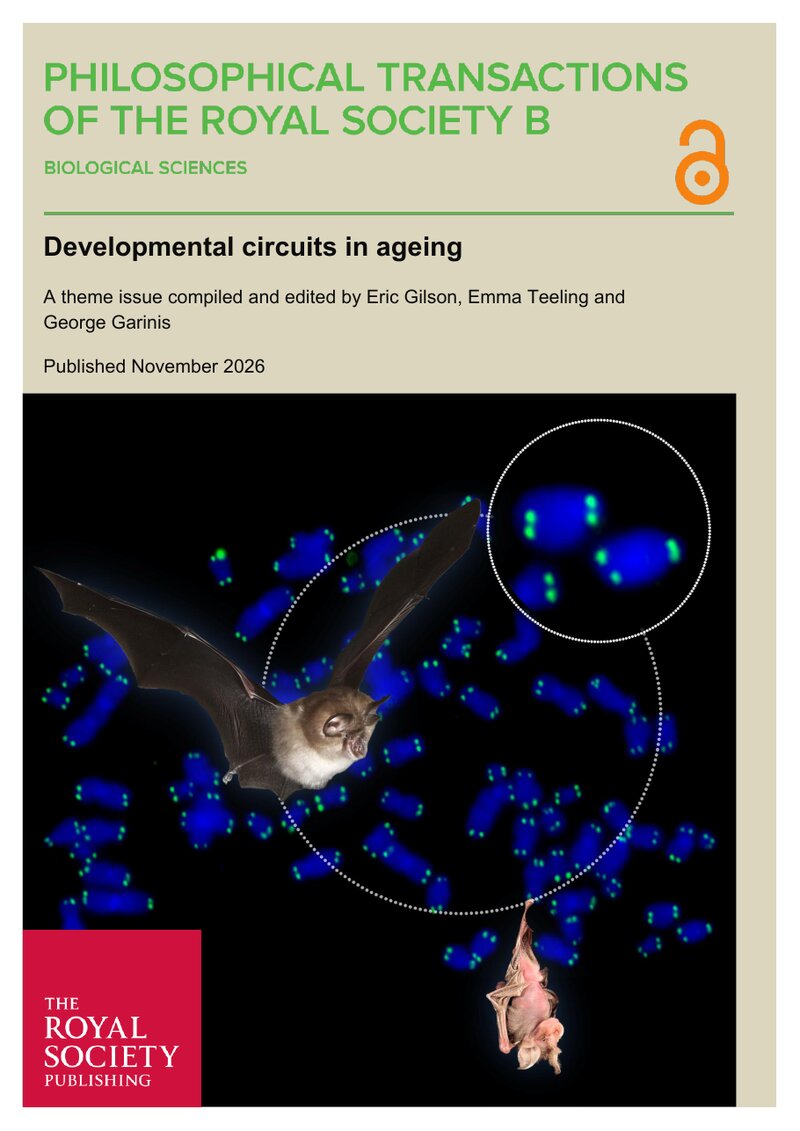
À propos de ce numéro
Quand commence-t-on à vieillir ? Ce numéro thématique montre que la réponse se trouve pendant le développement. Le vieillissement moléculaire commence dès l’embryon précoce, et la façon dont un organisme grandit, mûrit et se reproduit établit un programme de longévité adapté à son environnement et à sa physiologie. Les animaux qui renouvellent sans cesse leur corps, comme l’hydre ou les planaires, vieillissent à peine ; les mammifères et les oiseaux construisent des organes durables et vieillissent de façon plus visible. Les télomères raccourcissent dès le début de la vie chez certaines espèces mais pas chez d’autres, gardant la trace de conditions précoces comme le climat ou les soins parentaux. Le vieillissement peut débuter dans un organe et se propager aux autres, ce qui ouvre des fenêtres d’intervention : tôt dans la vie, ou plus tard, en bloquant cette propagation.
Accès
- Contenu en ligne : bit.ly/PTB1963
- Version imprimée au tarif réduit de 40 £ (au lieu de 65 £) en contactant l’équipe commerciale de la Royal Society (sales@royalsociety.org) avec le code promotionnel TB1963.
- Télécharger le flyer (PDF)
Sommaire
- Introduction: Ageing and development: two processes, one history — Eric Gilson, Emma Teeling et George Garinis
- Ageing begins early: developmental origins of ageing trajectories — Alibek Moldakozhayev et al.
- Development, stabilization and the shaping of ageing trajectories — Miria Ricchetti
- Rejuvenation in invertebrates and their relevance for ageing biology — Mickael Wurtz, Aldine Amiel et Eric Rottinger
- Setting the lifespan clock: anti-ageing interventions during development — Xusheng Hao et Ye Tian
- When genomes burn: how DNA damage ignites inflammation and fuels ageing — Emmanouil Theodorakis et George Garinis
- A role for p16High immune cells in disease tolerance as a crucial defence strategy — Dmitry Bulavin et Francisco Triana-Martinez
- Inflammaging as a dynamic process in ageing: context, regulation and functional consequences — Muhammad Ali et al.
- Non-canonical TRF2 control of retinal development — Ge Gao et al.
- Mosaic ageing: from organ-specific decline to the cause of death — Pablo Burraco et Jelle Boonekamp
- Organ communication in ageing — Giulia Allavena, Hervé Técher et Miguel G Ferreira
- Developmental epigenetic circuits and their epigenetic drift in skeletal muscle ageing — Laurent Schaeffer, Liudmila Afanaseva et Edwige Belotti
- Female-specific anti-ageing effects of TRF2 inhibition in skeletal myofibres — Eric Gilson et al.
- Reactivating young muscle regenerative pathways in ageing through inhibition of the ‘gerozyme’ 15-PGDH — Harutiun Nalbandian Geymonat et Helen Blau
- Sex and population mediate the ‘fast growth–short telomere’ association in two species of large herbivores monitored in the wild — Florentin Remot et al.
- Developmental processes in ageing: the role of growth regulation — Idalio Viegas et Joao P de Magalhaes
- Early-life reproductive success predicts lifespan: intrinsic quality, not reproductive trade-offs, explains heterogeneity in a short-lived vertebrate — Silvia Cattelan et Dario R Valenzano
- A phenotype-based ageing clock that reflects development rather than senescence in a wild mammal — Lucy Barnard et al.
- Early-life telomere length variation under changing developmental conditions in long-lived bats — Tadhg Lonergan et al.
- Cooperative care slows offspring telomere attrition and buffers growth against variable rainfall in a wild Kalahari bird — Pablo Capilla-Lasheras, Emma M Wood, Antony Brown et Andrew J Young
- Disentangling the paradox of inbreeding and telomere dynamics — Michael L Pepke et Morten T Limborg